Kazakhstan’s First Extradosed Bridge Reaches Major Construction Milestone in Pavlodar



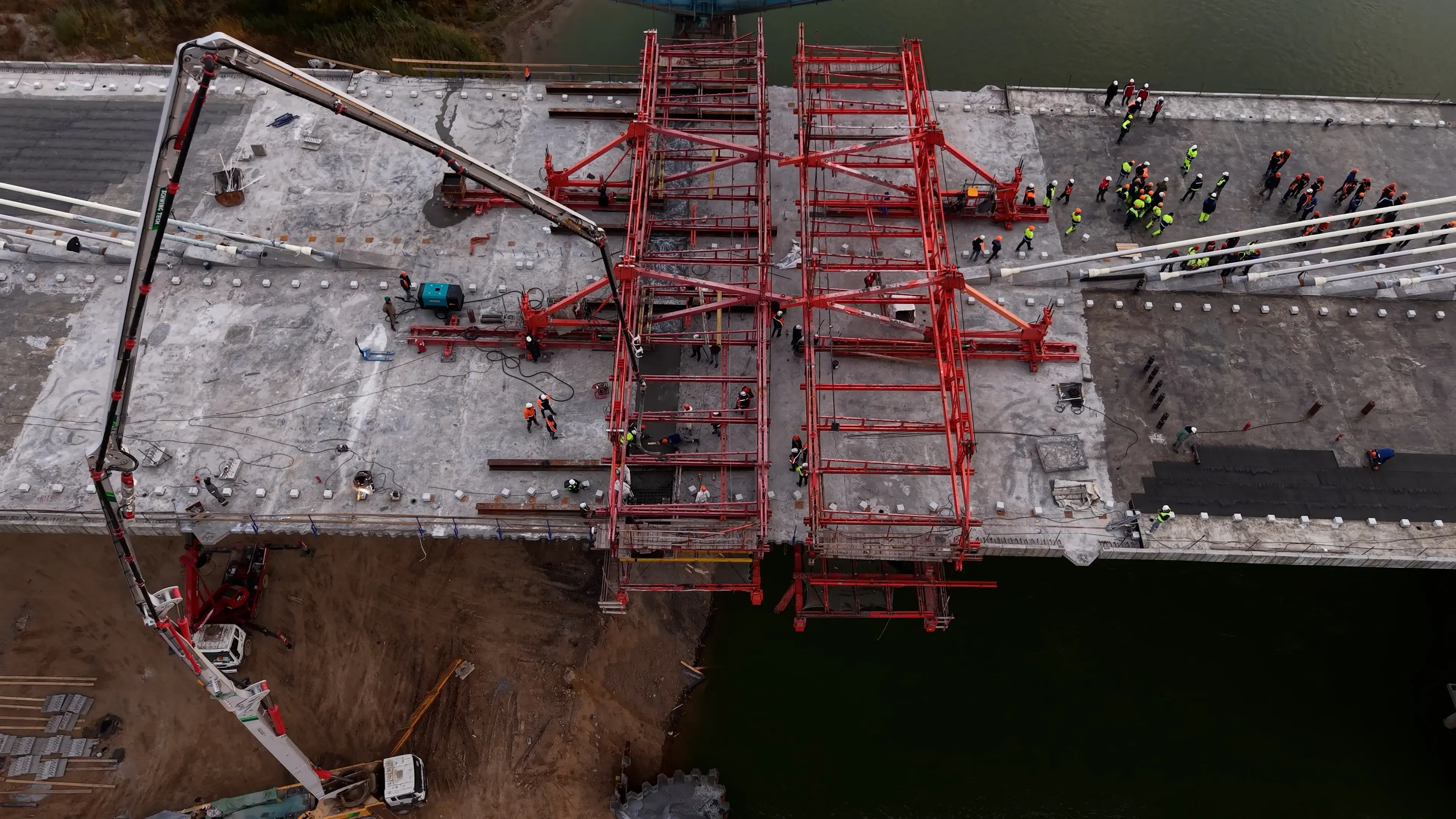
One of the key stages in the construction of a new road bridge across the Irtysh River in Pavlodar has been completed. Construction crews have achieved the final closure of the bridge span, connecting the sections built from opposite directions. The bridge is now 95% complete, with traffic scheduled to open in May 2027.
The new bridge will form part of Pavlodar’s Eastern Bypass, helping redistribute transit traffic and reduce pressure on the existing river crossing. The project is unique for Kazakhstan’s bridge construction industry: it is the country’s first extradosed bridge, combining the advantages of girder and cable-stayed structures.
The monolithic bridge superstructure measures 678 meters in length and 31.62 meters in width. Four low pylons and a system of external stay cables enable the bridge to span distances of up to 150 meters.
Construction is being carried out using the balanced cantilever method, which allows bridge spans to be built without temporary supports in the Irtysh riverbed. To achieve this, specialized construction equipment weighing 157 tonnes per unit was developed in cooperation with German specialists. Each unit can support up to 250 tonnes of freshly poured concrete and construct four-meter-long sections across the entire width of the bridge.
The final closure of the bridge spans proved particularly challenging. Engineers had to account for structural deflection, temperature effects, and concrete deformation. Surveying equipment and an automated monitoring system ensured the high precision required to connect the sections.
The hydrological conditions of the Irtysh River presented additional challenges, including considerable depth, strong currents, ice drift, and seasonal fluctuations in water levels. Dewatering and underwater concreting technologies were used during the construction of the bridge supports.
Currently, 311 specialists and 86 pieces of equipment are working on the project. According to Project Manager Nurmukhamet Besembayev, one of the most significant achievements has been building a strong team.
“For me, the greatest challenge was not so much the construction itself, although building a bridge of this kind across the Irtysh is an extremely complex engineering task. The most important thing was to build and maintain a strong team, bringing together specialists from different professions around a common goal. The final closure of the bridge spans marks the moment when years of hard work by hundreds of people came together in a single achievement. It once again proves that bridges are built not only with technology and machinery, but above all by people who know how to work as one team,” said Nurmukhamet Besembayev.
Following the completion of the span closure, construction crews will proceed with tensioning the high-strength reinforcement, waterproofing, laying the asphalt concrete pavement, and installing safety barriers. Construction of the approach road is also continuing in parallel.
The bridge itself is now 95% complete. Traffic is scheduled to open by the end of May 2027. The timeline has been adjusted to account for weather conditions and road surface quality requirements. The contractual completion date for the entire project remains unchanged: December 2027.
The new crossing will become a major transport artery for Pavlodar, improving logistics and creating additional opportunities for the development of the city and the wider region.